Airway substitution
The Vortex Approach categorises techniques to substitute between lifelines or a neck airway as either conversion or replacement. Conversion techniques are characterised by the ability to maintain continuous alveolar ventilation or the presence of a guide to reliably facilitate rapid restoration of alveolar ventilation (e.g. tracheal intubation via a supraglottic airway conduit). Conversely replacement techniques inevitably interrupt alveolar ventilation during substition of airways and do not employ a guide in the airway (e.g. removal of a supraglottic airway to attempt tracheal intubation) and are more accurately conceptualised as discontinuation of airway management coupled with planned immediate airway restoration using an alternative airway lifeline. As conversion techniques preserve the ability to maintain ‘airway success’ they are inherently safer than replacement techniques.
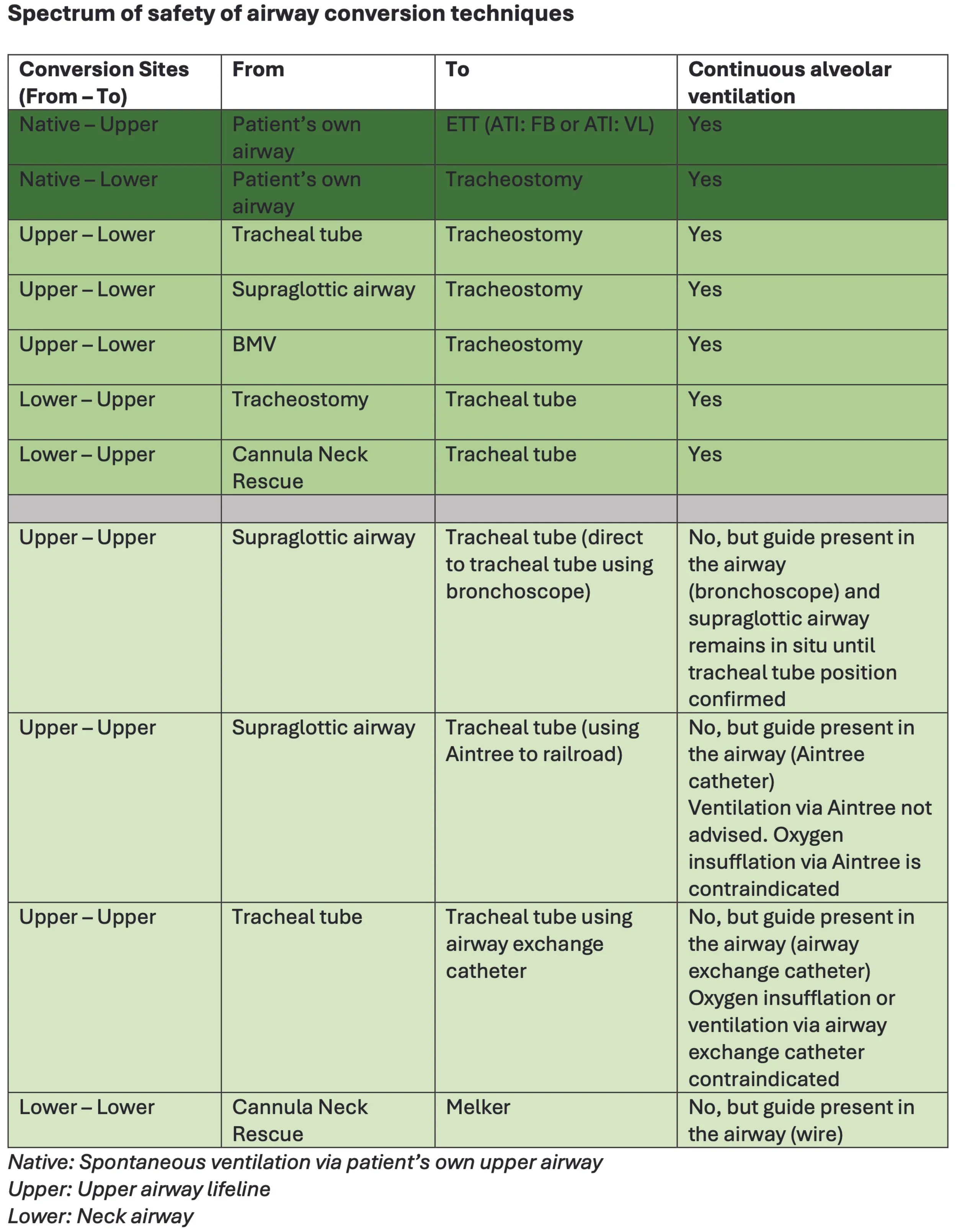
Conversion techniques lie on a spectrum of safety with the most conservative techniques providing the continous maintenance of alveolar ventilation and a guide to facilitate airway placement (e.g. awake tracheal intubation). At the other end of the spectrum conversion techniques transiently interrupt alveolar ventilation but still retain a guide to facilitate its rapid restoration (e.g. tracheal tube exchange using an airway exchange catheter).
The PUMA guidelines recognise the value of the distinction between conversion and replacement techniques to substitute between lifelines or a neck airway. The spectrum of safety of airway conversion techniques is outlined in the accompanying table.